
Our Movement from Local to Global: Who Is Responsible for the Desertifying World?
We officially launched Our Movement from Local to Global in November 2022. A year has passed; in between we lived through an earthquake and learned a great deal. This article, as of 5 December 2023, restates the purpose, the method and the current state of our movement.
What we want to do about climate change is, above all, to be pioneers of a current that starts locally and moves to the global. This may sound like an ambitious sentence; but we are writing from a village in Hatay, and that is exactly why we say it. Solutions to global problems are discussed at global summits; yet the hand that touches the soil, the farmer who drills the well, the producer who chooses the fertilizer are always local. If change does not begin with that hand, it does not begin anywhere.
Why from the local?
This issue, which we address under sustainable agriculture, one of the founding purposes of our cooperative, is as necessary and valid for the whole world as it is for us. This movement is not a matter small enough for five or ten institutions in each country to handle. Unfortunately we have no time to spend blaming global capital, global industry, global technology and agriculture companies, expecting the big steps from them, fighting them or protesting against them. That would be wasted effort. Our view is clear: the solution to a gigantic problem that concerns everyone is only possible through a movement from local to global. We will need to channel our greed and ambition into these issues and fight this global-scale problem together.
The essence of the movement: by talking, not fighting
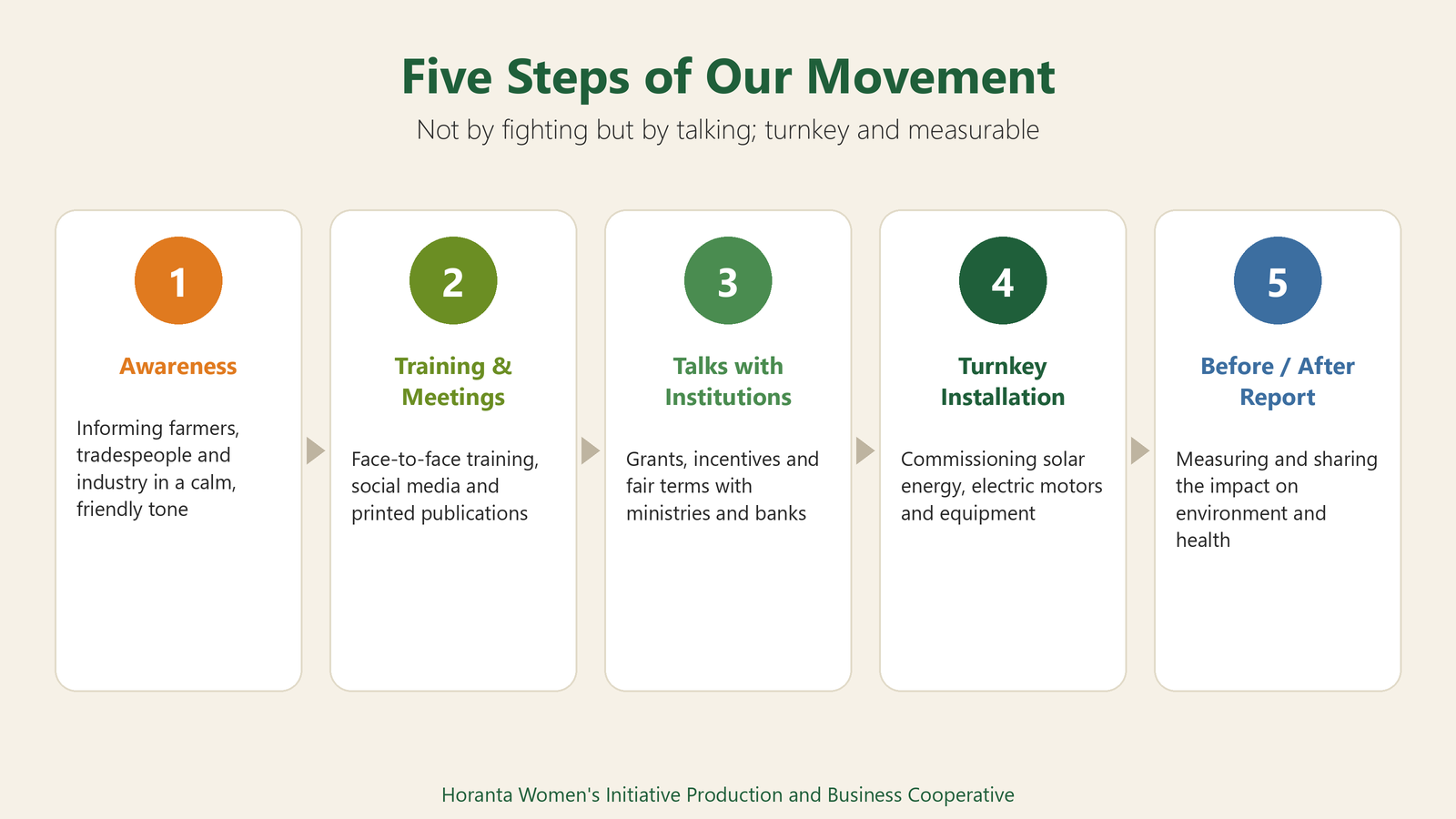
The steps we need to take, in order, are these:
- Awareness. Informing farmers, industrialists and every group that pollutes the environment about the situation in a kind and moderate tone. Not by fighting anyone, but by talking with them nicely.
- Training and meetings. Organising training sessions and meetings for greater awareness; through social media and printed publications, helping everyone become conscious of the issue and take a step of their own.
- Talks with institutions. Meeting with the Ministry of Agriculture, the Ministry of Trade and banks so that, first for our farmers and then for our tradespeople and industrialists, suitable payment terms, grants and incentives are created for the purchase of solar energy, electric motors, machinery and equipment.
- Turnkey installation. Identifying people’s needs, determining the steps to be taken, handling the paperwork and purchasing processes, and commissioning the equipment.
- Before and after reporting. Measuring and reporting the effect of the work on the environment and human health. If you cannot measure something, you cannot improve it.
In short, the summary of our project is this: to minimise the unconscious and careless use of water, energy, chemical fertilizer and chemical pesticide; and to put this in front of people as a turnkey service. That is our most fundamental duty.
Organic fertilizer, organic pesticide and the Model Organic Garden
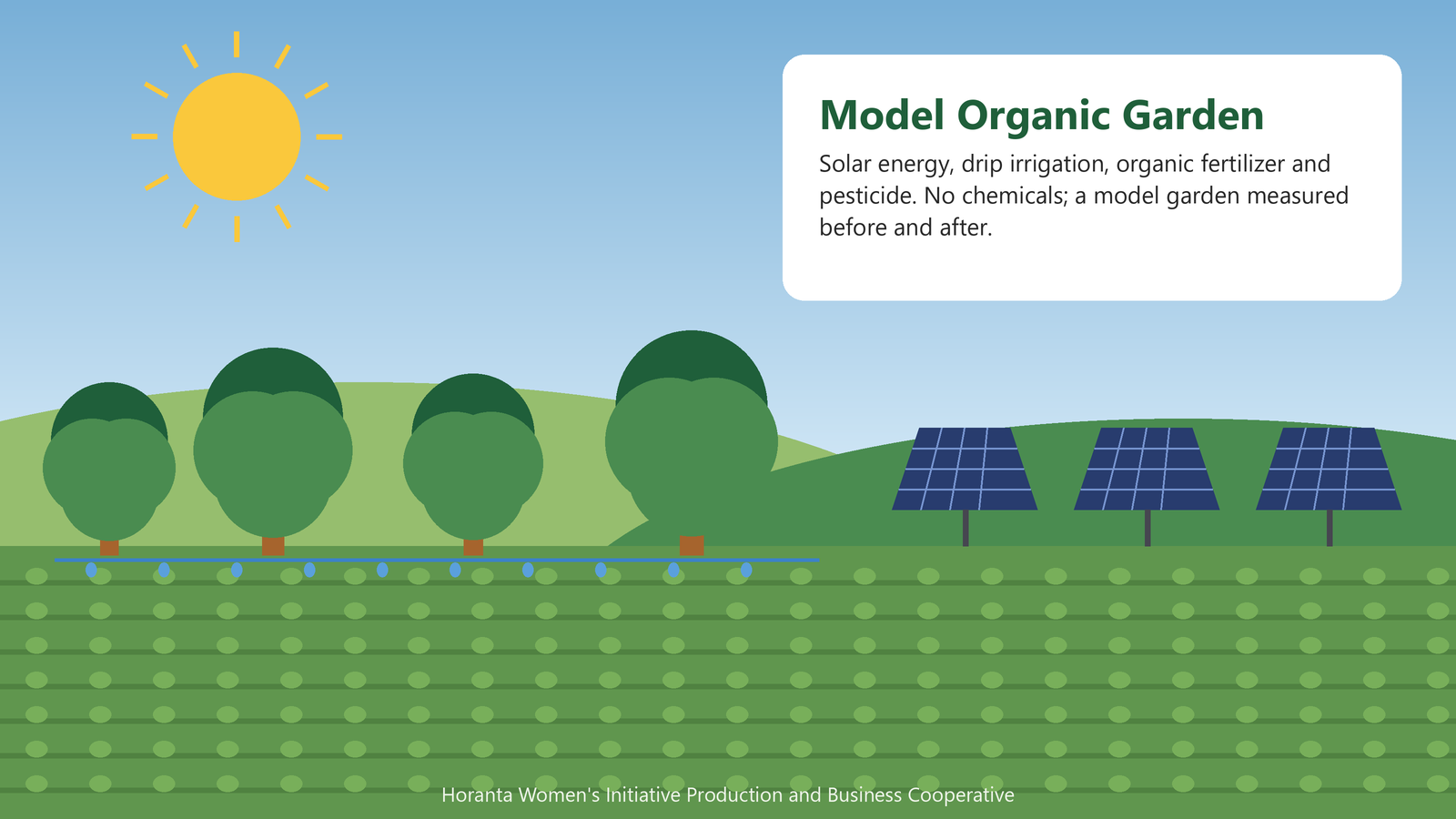
There is no one who does not know the harm chemical fertilizers and chemical pesticides do to nature and to human health. These two issues come first among the steps to be taken. That is why we have designated an integrated organic fertilizer and organic pesticide facility, which we believe must be established immediately and urgently, and a Model Organic Garden that anyone can come and see, as the concrete pillars of our movement. The garden will show solar-powered drip irrigation, chemical-free production and before-and-after soil analyses all in one place. Not words, but a field.
Energy: the most fundamental issue of the 21st century
One of the most fundamental problems of the 21st century must be the steep rise in energy prices. The tremendous surge in energy prices after the pandemic was more than enough to make people think seriously about the question “what will happen in the future”. Energy dependence is one of the issues every country in the world fears most.
While the ever-growing need for energy pushed countries into deep searches, an expanding industry consumed more energy and became more productive and more efficient. Humankind, wanting to live more modern, more comfortable lives, was in fact aware of how it was changing nature and the climate. Many of the steps taken to protect nature and the climate turned out to be very small steps. The effort of today’s technologies to protect nature is still insufficient. This is precisely why the solar panel in a farmer’s field, the panel on an industrialist’s roof, and an electric motor in place of diesel are for us not merely savings, but the movement itself.
Our grandchildren a hundred years from now
A hundred years from now, new generations with their groundwater exhausted, their soil turned to desert and living on the edge of hunger will debate behind our backs “how carelessly and greedily we ruined nature and the order of the universe”. Yes, sadly, our grandchildren may well be struggling with hunger and the problems of a desertifying world, and who knows what they will say about us. Please close your eyes and think about this for a moment. And then think about Our Movement from Local to Global.
There are endless sources where you can read about the causes and effects of climate change; we compiled them in our own words in our Climate Change Project article. Our movement also continues to share on this subject as stories on our social media accounts; please stay tuned.
Who is responsible for the desertifying world? Answer: everyone
The aim of our movement, which begins locally and reaches the global, is to know that climate change concerns all of us and to take the measures that need to be taken. We will talk not about the sources of the problems of the desertifying world, or to put it more accurately, the world we are turning into desert, but about their solutions. We have no time to look for culprits; because the culprit is all of us, and the solution lies with all of us too.
The aims of our cooperative and our project
Our first goal, among the greatest purposes behind the founding of our cooperative, is for agriculture to be more sustainable, more value-adding, less costly, and for land on which farming is still possible to be left to future generations. We have said this from the very beginning. In this context, the most serious and most difficult problem ahead of us stands out as climate change and drought. So our project moves forward under four headings:
- Climate change: awareness, training and talks with institutions.
- Drought: drought-tolerant species, drip irrigation, organic matter that increases the soil’s water-holding capacity.
- Carbon footprint: measuring and reducing the carbon footprint of our members and the businesses around us.
- Recycling of agricultural waste: turning pruning residue, straw and manure into organic fertilizer at the facility.
To be honest, at the end of the first year the earthquake made us progress more slowly than planned. But the basic idea of the movement is confirmed more with every passing day. We value and are interested in your different ideas on this subject. Please do not hesitate to reach us through our contact page. From local to global; starting from one village.