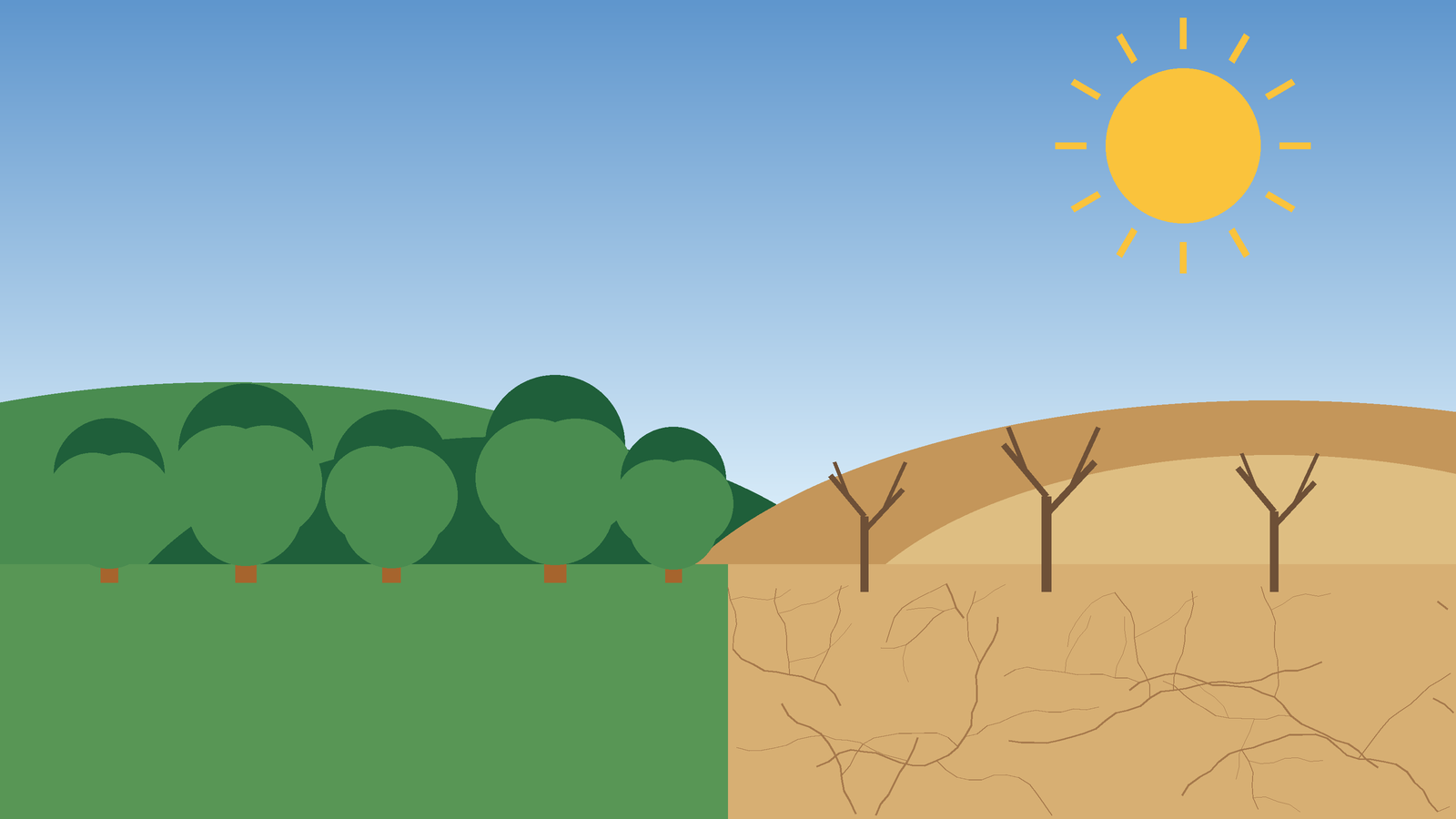
Our Climate Change Project: A Roadmap for Fighting Drought
Our climate change project with drought at its centre: the goal of greening 50 decares of scrubland with drought-tolerant forest fruits, without chemicals, between 2023 and 2028, and our eight-step roadmap.
We first published this article in February 2023, just before the earthquake. In the ten months since, both our region and our thinking have changed a great deal. As of 5 December 2023 we have rewritten it from scratch and placed drought at the very centre of our project.
Like everyone living in Hatay, we will remember this year by 6 February. The earthquake forced us to postpone some of the steps we had planned. But it also made one thing very clear: nature does not ask us. The heat we lived through all summer, the wells in the Amik Plain that keep getting deeper, and an autumn with almost no rain confirmed every sentence of this article in the field. It has been announced that 2023 is on course to be the hottest year on record; these days world leaders are gathered in Dubai at COP28. We, in our own village and at our own scale, have rewritten what we can do.
What is climate change?
Climate change is the emergence of long-term, measurable changes in the Earth’s climate system. It is the result of the interaction between the atmosphere, the oceans, glaciers and land; it unfolds over decades and centuries and shows its effects on a global scale. There are natural drivers too, but the main cause of the rapid change we are living through today is human activity: fossil fuel use, deforestation, industry and poor agricultural practices are increasing greenhouse gases in the atmosphere. These gases hold heat at the Earth’s surface; the result is global warming, sea level rise, extreme weather events and, the one we feel most, the decline of water resources.
The main drivers of climate change
Global warming
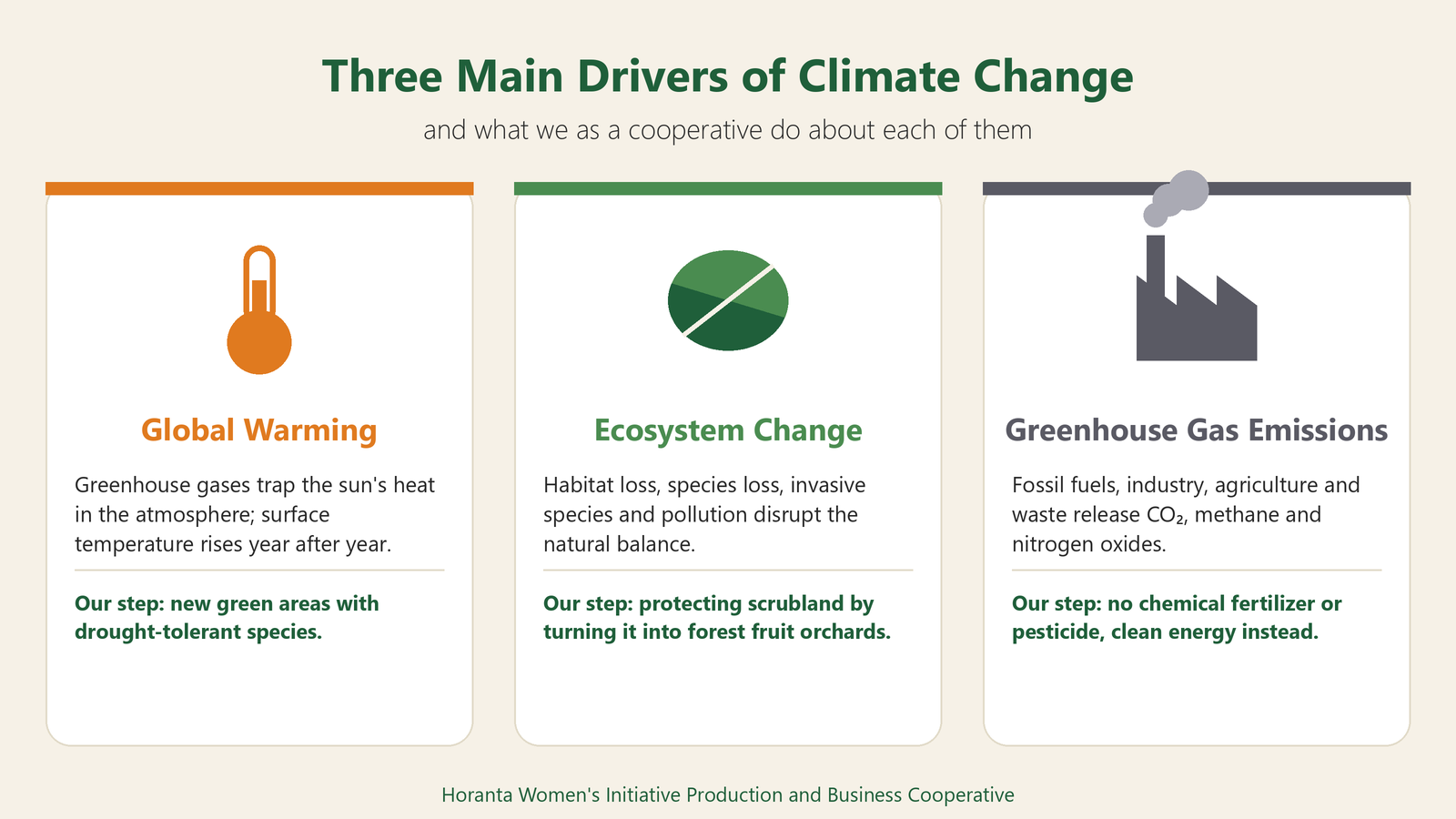
As greenhouse gases such as carbon dioxide, methane and water vapour accumulate in the atmosphere, the heat coming from the sun is trapped at the surface and the Earth’s surface temperature rises over the long term. The consequences are familiar: sea level rise, more frequent hurricanes and floods, drought, soil erosion and the loss of biodiversity. These effects touch not only nature but economic activity and the quality of life of all of us. On the solution side there is reducing greenhouse gas emissions, renewable energy, energy efficiency and sustainable development.
Ecosystem change
Destruction of forests, unplanned urbanisation, overuse of water resources, mining and pollution are changing ecosystems in ways that are hard to reverse. The result is habitat loss, extinction of species, the spread of invasive species and pollution. Climate change accelerates this chain. The remedy is also clear: creating protected areas, making forestry and agriculture sustainable, controlling invasive species, and preventing pollution at its source.
Greenhouse gas emissions
Greenhouse gases come from two sources. The natural ones are water vapour, carbon dioxide, methane and ozone. The human-made ones are carbon dioxide (CO₂), methane (CH₄), nitrogen oxides (NOx) and fluorinated gases released by fossil fuels, industry, agriculture, forestry and waste disposal. The real problem is the second group. The ways to reduce emissions are also known: clean energy, energy efficiency, zero-emission transport, protecting forests and creating new forest areas, and sustainable practices in agriculture. As a cooperative we have focused on the last two items on that list.
Drought: the most tangible consequence for us
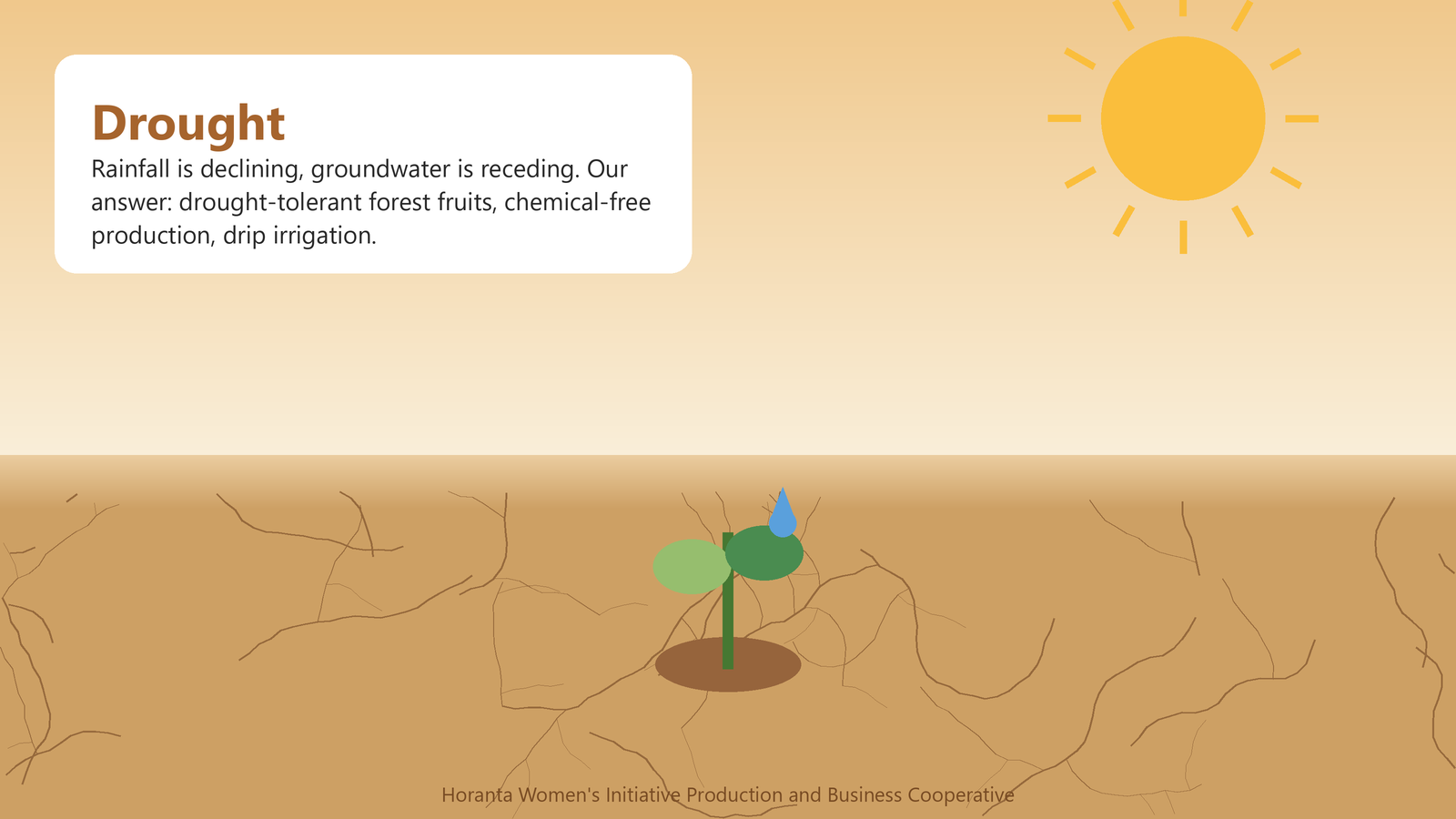
Every heading of climate change matters; but if you ask an agricultural engineer or a farmer in Kırıkhan, the answer is one word: drought. The rainfall pattern has broken down; the rain that should fall in winter either does not come or turns into a flood and runs off in a single day. The plain makes up the deficit with groundwater; the wells go a little deeper every year. If this pace continues, first irrigated farming and then village life itself will become unsustainable.
That is why we set two principles for our project. First, every species we plant must be drought-tolerant. Second, not a single drop of water must be wasted: drip irrigation, mulch covering the soil, and organic matter that increases the soil’s water-holding capacity. No chemical fertilizer or pesticide; because chemicals kill the life of the soil and with it its capacity to hold water.
How we designed our project
As a women’s initiative cooperative we sat down, talked at length and wrote down what we could do. Because of the earthquake we had to postpone some steps; but our plan is still the same.
- Choosing the topic. Climate change is a very wide field; it breaks down into many sub-topics such as greenhouse gas emissions, global temperature rise, sea level and ecosystem change. Our team of three agricultural engineers and one computer programmer decided to take on greenhouse gas emissions and global temperature rise.
- Research. We read widely on both topics and encountered very different views. The common point we arrived at was this: greenhouse gases are one of the biggest factors affecting our world. So what could a village cooperative do about it?
- Purpose. To reduce greenhouse gas emissions at our own scale and to create green areas that capture carbon from the atmosphere.
- Target. To cut the greenhouse gas emissions arising from our members’ activities by 10 percent and to protect the forest areas around us.
- Finding. In the provinces and districts where we live, we lose forest land every year to construction zones that spring up like mushrooms. The prevalence of maquis-type vegetation in our region shows that our forests have been left without an owner. This loss has to be stopped first.
- Analysis and decision. To increase the economic independence of our members and village stakeholders on one hand, and to give nature room to breathe on the other, we set the target of greening 50 decares of scrub and rocky land with forest fruits between 2023 and 2028.
- Solution. To provide income to our members and stakeholders by growing high value-added produce, to create employment, and to establish a large, orderly and well-kept green area that can capture greenhouse gases. While all this is done, no chemicals will be used and only drought-tolerant species will be planted. Our analysis shows that this approach can find support both from the local community and from national and international institutions.
- Reporting. We designed the project to create an effective forest area within three years and to bring an economic return as well. Every year we will measure the before and after and share it here.
Sustainable agriculture and what Industry 4.0 has taught us
The topic we insist on, and the greatest purpose behind founding our cooperative, is sustainable agriculture: the world’s largest industry, its oldest profession and its indispensable foundation. We must not allow our ambition to shorten the lives of future generations or to cause them serious health problems.
The trend all over the world these days is to step back, even a little, from the benefits industry provides; to live close to nature. We have all seen how concepts like Industry 3.0 and 4.0 have affected human life. We do not deny their blessings: transport became very easy and fast; our food became hygienic, varied, tasty and flawless in appearance; heating is now as easy as pressing a button. But the price is also high: our bodies became sluggish, our health slipped away, carbon dioxide increased. On this scale we choose to stand on nature’s side.
Our call to the authorities and to our members
It is essential that the issues we have discussed with the authorities are brought to a final decision urgently. Allocation of scrub and rocky land, support for drought-tolerant saplings and incentives for drip irrigation are not tasks a cooperative can shoulder alone. From our members and readers we ask only one thing: to see this not as a distant world issue, but as the issue of their own field and their own well. You can send us your ideas, suggestions and criticism through our contact page.

Related Posts
Keep Reading

Olive Oil and Thyme Brine: Benefits and Usage Guide
We have prepared a practical and reliable guide about Olive Oil and Thyme Brine: Benefits and Usage Guide.…
Sustainable Agriculture: Why We Were Founded, Where We Are Going
We wrote the first version of this article in autumn 2022, just before COP27 convened. In these days…
Our Movement from Local to Global: Who Is Responsible for the Desertifying World?
We officially launched Our Movement from Local to Global in November 2022. A year has passed; in between…