
Our Movement from Local to Global: Who Is Responsible for the Desertifying World?

We officially launched Our Movement from Local to Global in November 2022. A year has passed; in between we lived through an earthquake and learned a great deal. This article, as of 5 December 2023, restates the purpose, the method and the current state of our movement.

What we want to do about climate change is, above all, to be pioneers of a current that starts locally and moves to the global. This may sound like an ambitious sentence; but we are writing from a village in Hatay, and that is exactly why we say it. Solutions to global problems are discussed at global summits; yet the hand that touches the soil, the farmer who drills the well, the producer who chooses the fertilizer are always local. If change does not begin with that hand, it does not begin anywhere.

Why from the local?

This issue, which we address under sustainable agriculture, one of the founding purposes of our cooperative, is as necessary and valid for the whole world as it is for us. This movement is not a matter small enough for five or ten institutions in each country to handle. Unfortunately we have no time to spend blaming global capital, global industry, global technology and agriculture companies, expecting the big steps from them, fighting them or protesting against them. That would be wasted effort. Our view is clear: the solution to a gigantic problem that concerns everyone is only possible through a movement from local to global. We will need to channel our greed and ambition into these issues and fight this global-scale problem together.

The essence of the movement: by talking, not fighting
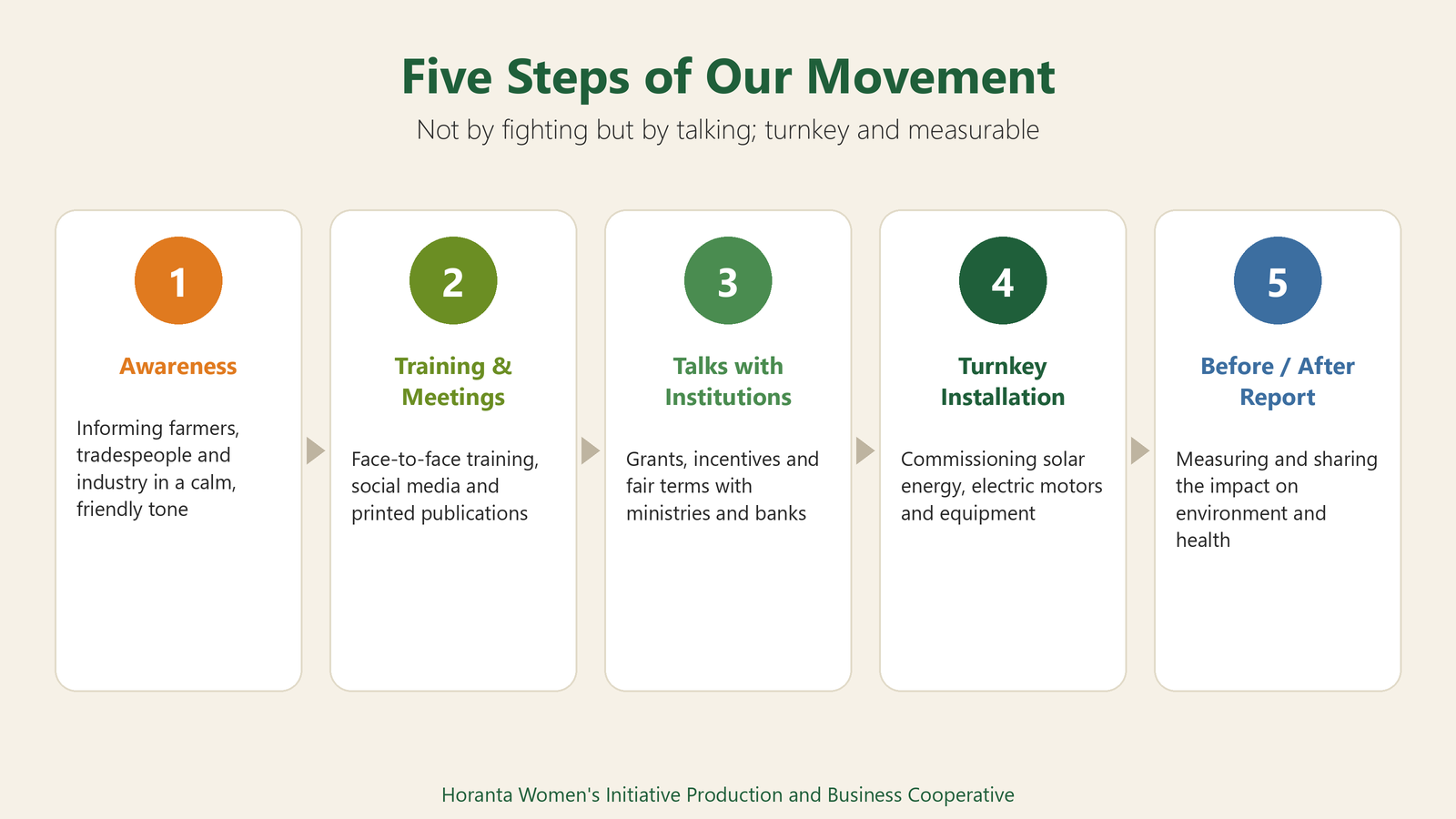
By talking, not fighting: five steps from awareness to reporting.

The steps we need to take, in order, are these:

  1. Awareness. Informing farmers, industrialists and every group that pollutes the environment about the situation in a kind and moderate tone. Not by fighting anyone, but by talking with them nicely.
  2. Training and meetings. Organising training sessions and meetings for greater awareness; through social media and printed publications, helping everyone become conscious of the issue and take a step of their own.
  3. Talks with institutions. Meeting with the Ministry of Agriculture, the Ministry of Trade and banks so that, first for our farmers and then for our tradespeople and industrialists, suitable payment terms, grants and incentives are created for the purchase of solar energy, electric motors, machinery and equipment.
  4. Turnkey installation. Identifying people’s needs, determining the steps to be taken, handling the paperwork and purchasing processes, and commissioning the equipment.
  5. Before and after reporting. Measuring and reporting the effect of the work on the environment and human health. If you cannot measure something, you cannot improve it.

In short, the summary of our project is this: to minimise the unconscious and careless use of water, energy, chemical fertilizer and chemical pesticide; and to put this in front of people as a turnkey service. That is our most fundamental duty.

Organic fertilizer, organic pesticide and the Model Organic Garden
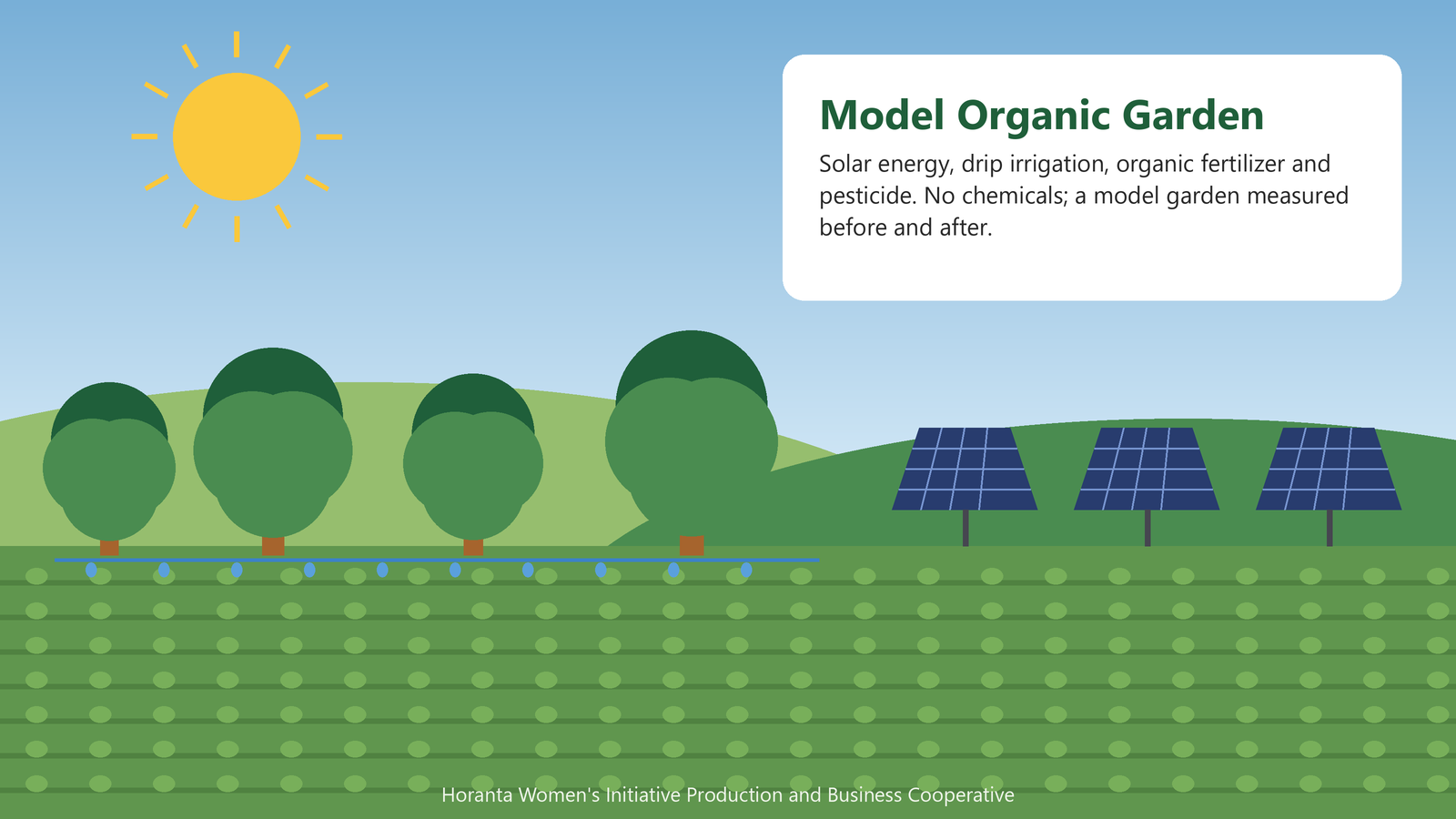
Model Organic Garden: solar energy, drip irrigation, organic fertilizer and pesticide; a model measured before and after.

There is no one who does not know the harm chemical fertilizers and chemical pesticides do to nature and to human health. These two issues come first among the steps to be taken. That is why we have designated an integrated organic fertilizer and organic pesticide facility, which we believe must be established immediately and urgently, and a Model Organic Garden that anyone can come and see, as the concrete pillars of our movement. The garden will show solar-powered drip irrigation, chemical-free production and before-and-after soil analyses all in one place. Not words, but a field.

Energy: the most fundamental issue of the 21st century

One of the most fundamental problems of the 21st century must be the steep rise in energy prices. The tremendous surge in energy prices after the pandemic was more than enough to make people think seriously about the question “what will happen in the future”. Energy dependence is one of the issues every country in the world fears most.

While the ever-growing need for energy pushed countries into deep searches, an expanding industry consumed more energy and became more productive and more efficient. Humankind, wanting to live more modern, more comfortable lives, was in fact aware of how it was changing nature and the climate. Many of the steps taken to protect nature and the climate turned out to be very small steps. The effort of today’s technologies to protect nature is still insufficient. This is precisely why the solar panel in a farmer’s field, the panel on an industrialist’s roof, and an electric motor in place of diesel are for us not merely savings, but the movement itself.

Our grandchildren a hundred years from now

A hundred years from now, new generations with their groundwater exhausted, their soil turned to desert and living on the edge of hunger will debate behind our backs “how carelessly and greedily we ruined nature and the order of the universe”. Yes, sadly, our grandchildren may well be struggling with hunger and the problems of a desertifying world, and who knows what they will say about us. Please close your eyes and think about this for a moment. And then think about Our Movement from Local to Global.

There are endless sources where you can read about the causes and effects of climate change; we compiled them in our own words in our Climate Change Project article. Our movement also continues to share on this subject as stories on our social media accounts; please stay tuned.

Who is responsible for the desertifying world? Answer: everyone

The aim of our movement, which begins locally and reaches the global, is to know that climate change concerns all of us and to take the measures that need to be taken. We will talk not about the sources of the problems of the desertifying world, or to put it more accurately, the world we are turning into desert, but about their solutions. We have no time to look for culprits; because the culprit is all of us, and the solution lies with all of us too.

The aims of our cooperative and our project

Our first goal, among the greatest purposes behind the founding of our cooperative, is for agriculture to be more sustainable, more value-adding, less costly, and for land on which farming is still possible to be left to future generations. We have said this from the very beginning. In this context, the most serious and most difficult problem ahead of us stands out as climate change and drought. So our project moves forward under four headings:

  • Climate change: awareness, training and talks with institutions.
  • Drought: drought-tolerant species, drip irrigation, organic matter that increases the soil’s water-holding capacity.
  • Carbon footprint: measuring and reducing the carbon footprint of our members and the businesses around us.
  • Recycling of agricultural waste: turning pruning residue, straw and manure into organic fertilizer at the facility.

To be honest, at the end of the first year the earthquake made us progress more slowly than planned. But the basic idea of the movement is confirmed more with every passing day. We value and are interested in your different ideas on this subject. Please do not hesitate to reach us through our contact page. From local to global; starting from one village.
Our Climate Change Project: A Roadmap for Fighting Drought

We first published this article in February 2023, just before the earthquake. In the ten months since, both our region and our thinking have changed a great deal. As of 5 December 2023 we have rewritten it from scratch and placed drought at the very centre of our project.

Like everyone living in Hatay, we will remember this year by 6 February. The earthquake forced us to postpone some of the steps we had planned. But it also made one thing very clear: nature does not ask us. The heat we lived through all summer, the wells in the Amik Plain that keep getting deeper, and an autumn with almost no rain confirmed every sentence of this article in the field. It has been announced that 2023 is on course to be the hottest year on record; these days world leaders are gathered in Dubai at COP28. We, in our own village and at our own scale, have rewritten what we can do.

What is climate change?

Climate change is the emergence of long-term, measurable changes in the Earth’s climate system. It is the result of the interaction between the atmosphere, the oceans, glaciers and land; it unfolds over decades and centuries and shows its effects on a global scale. There are natural drivers too, but the main cause of the rapid change we are living through today is human activity: fossil fuel use, deforestation, industry and poor agricultural practices are increasing greenhouse gases in the atmosphere. These gases hold heat at the Earth’s surface; the result is global warming, sea level rise, extreme weather events and, the one we feel most, the decline of water resources.

The main drivers of climate change

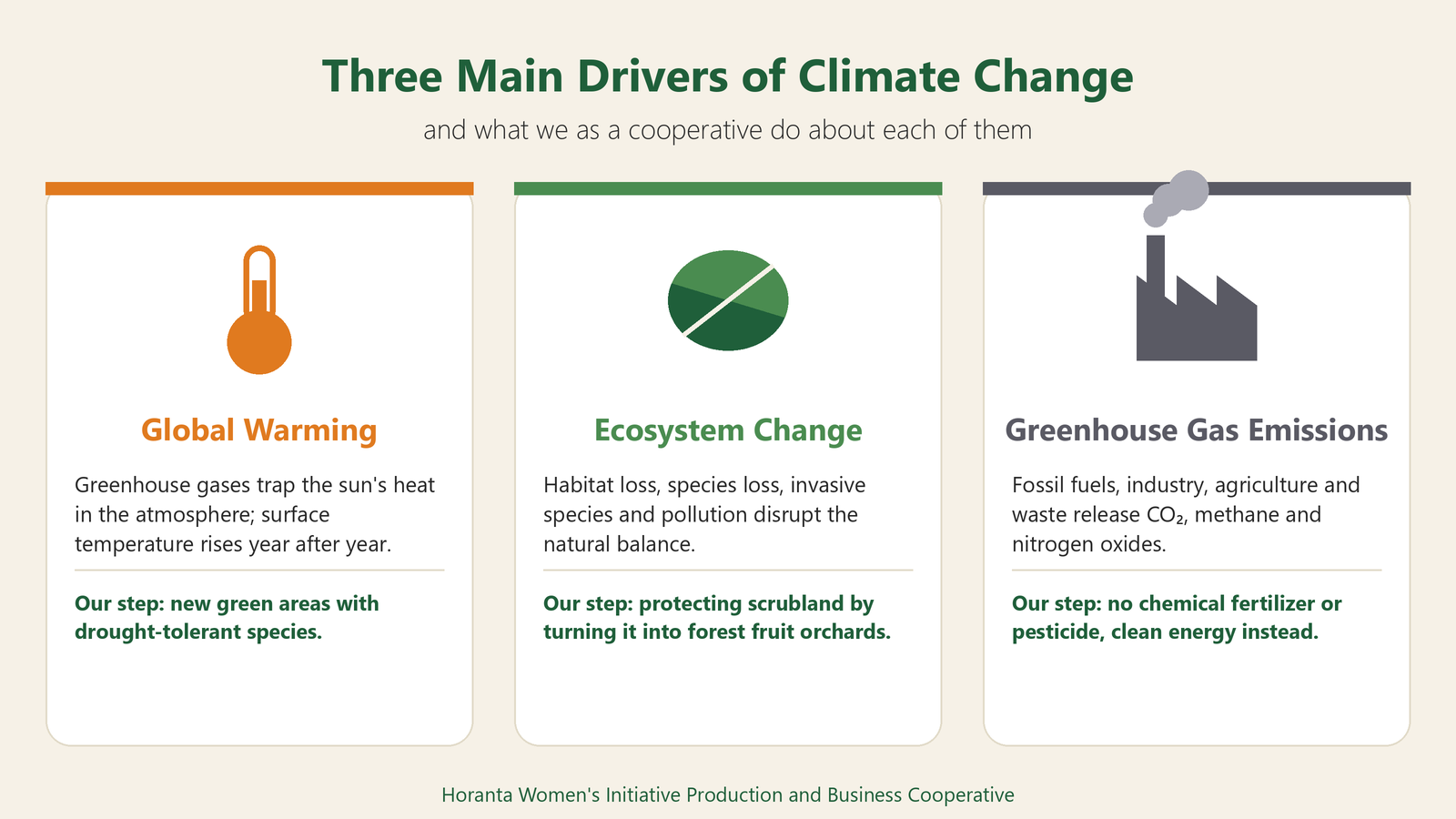
Global warming, ecosystem change and greenhouse gas emissions; we have our own step against each.

Global warming

As greenhouse gases such as carbon dioxide, methane and water vapour accumulate in the atmosphere, the heat coming from the sun is trapped at the surface and the Earth’s surface temperature rises over the long term. The consequences are familiar: sea level rise, more frequent hurricanes and floods, drought, soil erosion and the loss of biodiversity. These effects touch not only nature but economic activity and the quality of life of all of us. On the solution side there is reducing greenhouse gas emissions, renewable energy, energy efficiency and sustainable development.

Ecosystem change

Destruction of forests, unplanned urbanisation, overuse of water resources, mining and pollution are changing ecosystems in ways that are hard to reverse. The result is habitat loss, extinction of species, the spread of invasive species and pollution. Climate change accelerates this chain. The remedy is also clear: creating protected areas, making forestry and agriculture sustainable, controlling invasive species, and preventing pollution at its source.

Greenhouse gas emissions

Greenhouse gases come from two sources. The natural ones are water vapour, carbon dioxide, methane and ozone. The human-made ones are carbon dioxide (CO₂), methane (CH₄), nitrogen oxides (NOx) and fluorinated gases released by fossil fuels, industry, agriculture, forestry and waste disposal. The real problem is the second group. The ways to reduce emissions are also known: clean energy, energy efficiency, zero-emission transport, protecting forests and creating new forest areas, and sustainable practices in agriculture. As a cooperative we have focused on the last two items on that list.

Drought: the most tangible consequence for us

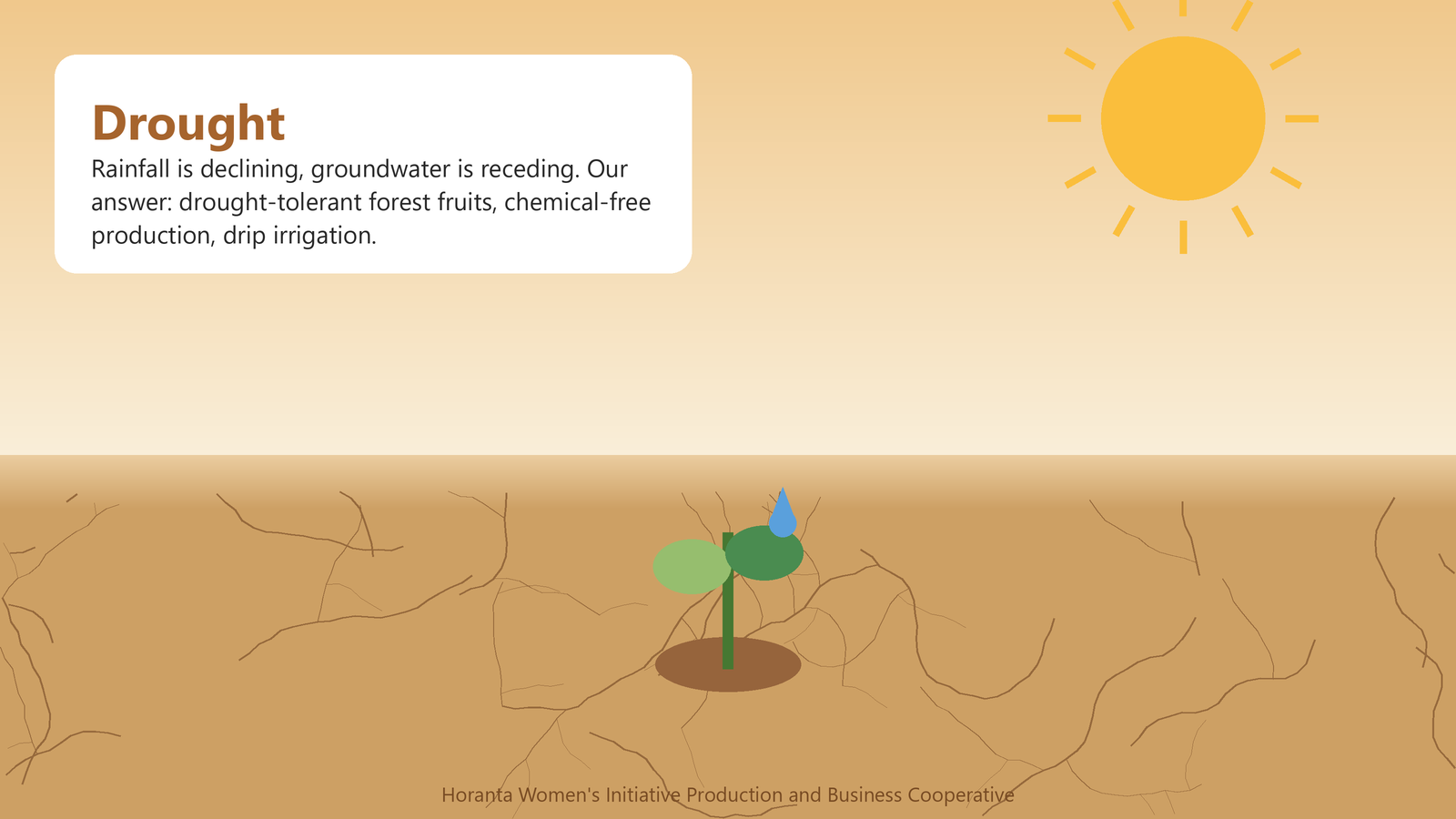
Rainfall is declining, wells are getting deeper. Our answer: drought-tolerant species and chemical-free production.

Every heading of climate change matters; but if you ask an agricultural engineer or a farmer in Kırıkhan, the answer is one word: drought. The rainfall pattern has broken down; the rain that should fall in winter either does not come or turns into a flood and runs off in a single day. The plain makes up the deficit with groundwater; the wells go a little deeper every year. If this pace continues, first irrigated farming and then village life itself will become unsustainable.

That is why we set two principles for our project. First, every species we plant must be drought-tolerant. Second, not a single drop of water must be wasted: drip irrigation, mulch covering the soil, and organic matter that increases the soil’s water-holding capacity. No chemical fertilizer or pesticide; because chemicals kill the life of the soil and with it its capacity to hold water.

How we designed our project

As a women’s initiative cooperative we sat down, talked at length and wrote down what we could do. Because of the earthquake we had to postpone some steps; but our plan is still the same.

  1. Choosing the topic. Climate change is a very wide field; it breaks down into many sub-topics such as greenhouse gas emissions, global temperature rise, sea level and ecosystem change. Our team of three agricultural engineers and one computer programmer decided to take on greenhouse gas emissions and global temperature rise.
  2. Research. We read widely on both topics and encountered very different views. The common point we arrived at was this: greenhouse gases are one of the biggest factors affecting our world. So what could a village cooperative do about it?
  3. Purpose. To reduce greenhouse gas emissions at our own scale and to create green areas that capture carbon from the atmosphere.
  4. Target. To cut the greenhouse gas emissions arising from our members’ activities by 10 percent and to protect the forest areas around us.
  5. Finding. In the provinces and districts where we live, we lose forest land every year to construction zones that spring up like mushrooms. The prevalence of maquis-type vegetation in our region shows that our forests have been left without an owner. This loss has to be stopped first.
  6. Analysis and decision. To increase the economic independence of our members and village stakeholders on one hand, and to give nature room to breathe on the other, we set the target of greening 50 decares of scrub and rocky land with forest fruits between 2023 and 2028.
  7. Solution. To provide income to our members and stakeholders by growing high value-added produce, to create employment, and to establish a large, orderly and well-kept green area that can capture greenhouse gases. While all this is done, no chemicals will be used and only drought-tolerant species will be planted. Our analysis shows that this approach can find support both from the local community and from national and international institutions.
  8. Reporting. We designed the project to create an effective forest area within three years and to bring an economic return as well. Every year we will measure the before and after and share it here.

Sustainable agriculture and what Industry 4.0 has taught us

The topic we insist on, and the greatest purpose behind founding our cooperative, is sustainable agriculture: the world’s largest industry, its oldest profession and its indispensable foundation. We must not allow our ambition to shorten the lives of future generations or to cause them serious health problems.

The trend all over the world these days is to step back, even a little, from the benefits industry provides; to live close to nature. We have all seen how concepts like Industry 3.0 and 4.0 have affected human life. We do not deny their blessings: transport became very easy and fast; our food became hygienic, varied, tasty and flawless in appearance; heating is now as easy as pressing a button. But the price is also high: our bodies became sluggish, our health slipped away, carbon dioxide increased. On this scale we choose to stand on nature’s side.

Our call to the authorities and to our members

It is essential that the issues we have discussed with the authorities are brought to a final decision urgently. Allocation of scrub and rocky land, support for drought-tolerant saplings and incentives for drip irrigation are not tasks a cooperative can shoulder alone. From our members and readers we ask only one thing: to see this not as a distant world issue, but as the issue of their own field and their own well. You can send us your ideas, suggestions and criticism through our contact page.